

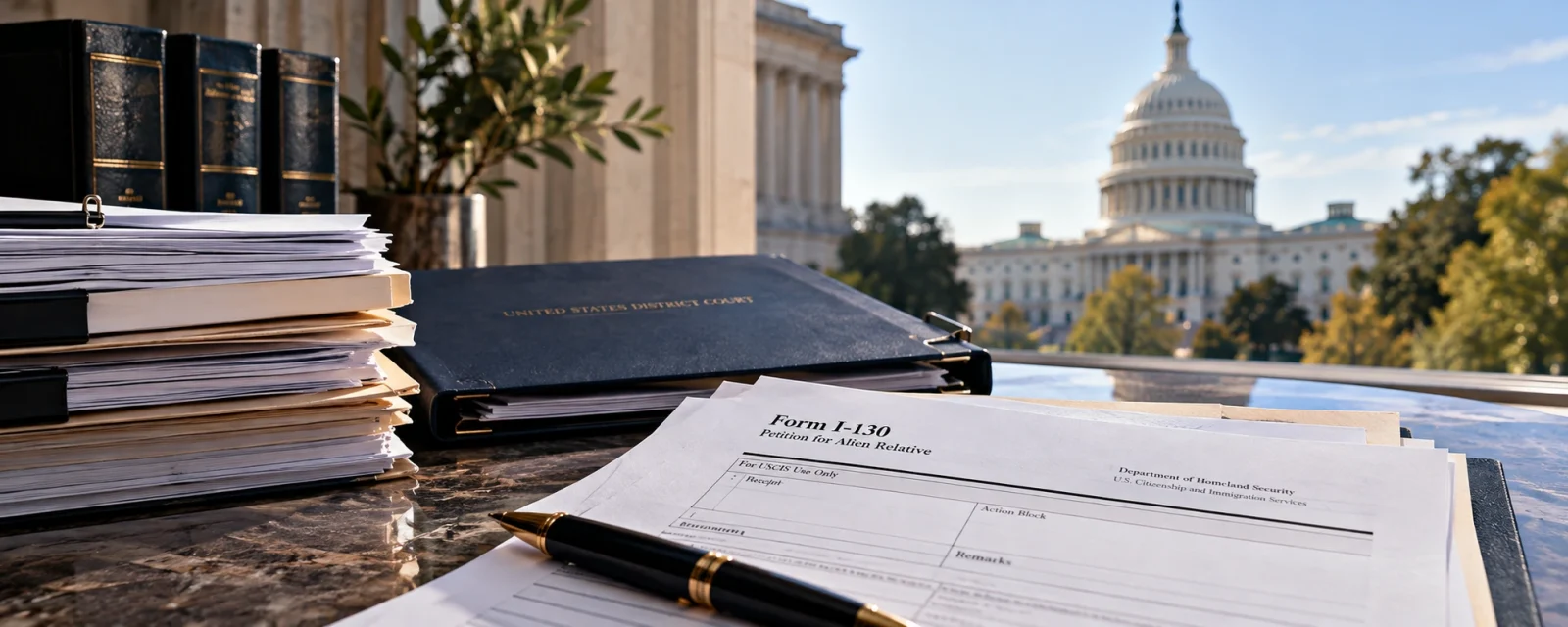
A delayed I-130 mandamus lawsuit may be considered when a family-based petition has remained pending with USCIS for an unusually long period without a final decision. In this matter, the I-130 remained pending for more than 16 months before a federal mandamus lawsuit was filed. USCIS approved the petition just 12 days after the lawsuit was filed.
Can a Delayed I-130 Be Challenged in Federal Court?
Potentially. When an I-130 has remained pending for an extended period without meaningful progress, a federal mandamus or unreasonable-delay action may be one option worth evaluating. There is no universal waiting period, and filing a lawsuit does not guarantee approval. The length of the delay, USCIS activity, procedural history, underlying petition, and applicable federal law should all be reviewed before filing.
An I-130 Petition That Remained Pending for More Than 16 Months
Form I-130, Petition for Alien Relative, allows qualifying U.S. citizens and lawful permanent residents to petition for certain qualifying family members. In this matter, a U.S. citizen filed an I-130 petition for a spouse.
USCIS received the petition in April 2025. The petition then remained pending for more than 16 months without a final decision. Despite the length of the pending period, USCIS had not completed adjudication of the petition.
After the prolonged delay, the petitioner pursued federal litigation seeking action on the pending I-130 petition.
For current filing requirements and general information about Form I-130, see the official USCIS Form I-130 page.
The length of the delay matters. An I-130 does not automatically become appropriate for federal litigation after a specific number of months. The complete processing history and circumstances of the individual case should be evaluated.
Why Was a Federal Mandamus Lawsuit Filed?
A delayed I-130 mandamus lawsuit may be considered when an immigration petition has remained unresolved for a prolonged period and the circumstances support a claim that agency action has been unreasonably delayed.
There is no single fact that determines whether federal litigation is appropriate. A case-specific review may consider several circumstances.
- The overall length of the delay. The filing date matters, but the complete processing history is more important than simply counting months.
- What USCIS has done during the pending period. Requests for Evidence, background checks, transfers, interviews, service requests, and other agency activity may affect the analysis.
- Whether the petition appears ready for adjudication. Outstanding evidence or unresolved eligibility issues may affect both processing and litigation strategy.
- Prior efforts to obtain agency action. USCIS inquiries, congressional assistance, Ombudsman requests, and other correspondence may help document the history of the delay.
- The law in the relevant federal court. Jurisdiction, venue, and the standards applied to unreasonable-delay claims should be evaluated before filing.
USCIS processing-time information can provide useful context, but being outside a published processing range does not automatically establish that a federal delay claim will succeed.
What an I-130 Mandamus Lawsuit Can and Cannot Do
A mandamus or unreasonable-delay lawsuit generally seeks action on a pending government matter. It does not ask a federal judge to approve the I-130 petition personally.
In an appropriate case, federal litigation may seek an order requiring the government to take legally required action. USCIS nevertheless remains responsible for adjudicating the underlying immigration petition.
What the lawsuit may seek
A federal action may seek agency movement or adjudicative action on an I-130 petition that has allegedly remained pending for an unreasonable period.
What the lawsuit does not guarantee
Mandamus does not guarantee approval, a particular processing timeline, or a specific USCIS decision.
Mandamus addresses delay, not eligibility. USCIS remains responsible for determining whether the I-130 satisfies the applicable immigration requirements.
A Delayed I-130 Approved Shortly After Federal Litigation Began
This matter involved an I-130 petition that remained pending for more than 16 months before federal litigation was filed.
I-130 Filed
USCIS received the I-130 petition filed for a spouse. The petition then remained pending without a final decision.
Federal Lawsuit Filed
After more than 16 months of delay, a federal mandamus lawsuit was filed concerning the pending I-130 petition. The defendants were served two days after filing.
I-130 Approved
USCIS approved the I-130 just 12 days after the federal mandamus lawsuit was filed.
I-130 Approved 12 Days After the Mandamus Lawsuit Was Filed
USCIS approved the I-130 in October 2026, just 12 days after the federal mandamus lawsuit was filed. Because the defendants were served two days after filing, the approval occurred approximately 10 days after service. The approval concluded a petition that had remained pending for more than 16 months before the federal lawsuit was filed.
This I-130 mandamus case result does not establish that filing a federal lawsuit automatically causes USCIS to approve a petition. Every immigration matter has its own procedural history, eligibility requirements, and agency considerations.
What Happened After the I-130 Mandamus Lawsuit Was Filed?
The federal lawsuit was filed after the I-130 had remained pending for more than 16 months. The defendants were served two days after the lawsuit was filed. USCIS then approved the petition just 12 days after the federal lawsuit was filed.
Federal Litigation Was Initiated
The petitioner filed a federal mandamus lawsuit seeking action on the long-pending I-130 petition.
The Defendants Were Served
The defendants were served two days after the federal lawsuit was filed.
USCIS Approved the I-130
USCIS approved the petition 12 days after the federal mandamus lawsuit was filed.
The Underlying Petition Was Resolved
The approval brought the prolonged I-130 adjudication to a conclusion.
This was a case-specific result. A federal delay lawsuit does not create a predetermined USCIS response. Depending on the circumstances, USCIS may continue processing, request additional evidence, schedule an interview, approve the petition, deny the petition, or take another legally available action.
What Should Be Reviewed Before Filing an I-130 Mandamus Lawsuit?
Before considering federal litigation, assemble a clear record of the I-130 petition and its processing history. This helps identify whether the matter appears stalled, whether USCIS has provided an explanation, and whether there are unresolved issues affecting the petition.
- The I-130 receipt notice and original filing date.
- USCIS online case-status history and any changes in processing.
- Requests for Evidence, notices, and submitted responses.
- USCIS service requests and agency responses.
- Congressional or CIS Ombudsman communications, if applicable.
- Any known security, background, or administrative review issues.
- A complete review of the underlying I-130 petition and eligibility.
- The appropriate federal district, venue, and potential defendants.
Prior efforts to obtain agency action may also be relevant to the litigation strategy. Federal jurisdiction and venue are legal questions that depend on the circumstances of the proposed lawsuit.
I-130 Mandamus Lawsuit FAQs
Select a question to read the answer.
Can I sue USCIS if my I-130 has been pending for a long time?
Potentially. A prolonged delay may justify evaluating federal litigation, but the length of the delay alone does not determine whether a viable claim exists. The petition history, USCIS activity, applicable law, and other circumstances should be reviewed.
How long should an I-130 be pending before filing mandamus?
There is no universal waiting period. The analysis may consider how long the petition has been pending, what USCIS has done during that period, whether a known reason for the delay exists, and the federal-law standards applicable to the proposed case.
Does an I-130 mandamus lawsuit guarantee approval?
No. A lawsuit challenging delay does not guarantee approval of the underlying petition. USCIS remains responsible for deciding whether the I-130 satisfies the applicable immigration requirements.
How quickly was this I-130 approved after mandamus was filed?
USCIS approved this I-130 12 days after the federal mandamus lawsuit was filed.
When were the defendants served in this case?
The defendants were served two days after the federal mandamus lawsuit was filed.
How quickly was the I-130 approved after service?
The I-130 was approved approximately 10 days after the defendants were served.
Can USCIS deny an I-130 after a mandamus lawsuit is filed?
Yes. A delay lawsuit does not change the substantive eligibility requirements or guarantee a favorable decision. USCIS may approve, deny, request additional evidence, or otherwise continue adjudicating the petition.
Where is an I-130 mandamus lawsuit filed?
Mandamus and unreasonable-delay actions are filed in federal district court. Determining the appropriate court requires an analysis of federal jurisdiction, venue, the parties, and the facts of the proposed lawsuit.
Do I need to make USCIS inquiries before filing mandamus?
Prior inquiries may help document efforts to obtain action and may be useful in evaluating the delay. However, there is no universal rule requiring every applicant to complete every possible administrative inquiry before every federal delay lawsuit. The appropriate approach depends on the individual case and applicable law.
How long does an I-130 mandamus lawsuit take?
There is no guaranteed timeline. The government’s response, USCIS activity, the assigned court, service of process, and any contested motions can affect how long the federal case remains pending.
A Long-Pending I-130 Was Approved Shortly After Federal Litigation Began
An I-130 mandamus lawsuit may be one option worth evaluating when a family-based petition has remained pending for an unusually long period without meaningful progress.
In this matter, the I-130 remained pending for more than 16 months before the federal lawsuit was filed. The defendants were served two days later, and USCIS approved the petition just 12 days after the lawsuit was filed.
The result demonstrates what happened in one particular case. It does not mean that every delayed I-130 should be taken to federal court or that another case will produce the same timeline or outcome.
The appropriate strategy depends on the individual petition, the length and circumstances of the delay, prior agency activity, potential litigation risks, jurisdiction, venue, and the applicable law.
Request a Free Mandamus Case Evaluation to provide information about your delayed immigration matter.
This article provides general information, not legal advice. Federal jurisdiction and the legal standards applicable to delayed immigration petitions can vary. Prior case outcomes do not guarantee or predict similar results in another matter.